2.4 Creating Admin Accounts and Managing Permissions
To manage your Tokenizer.Estate platform, you can create multiple admin accounts with different roles and permissions. This ensures secure, role-based access control and accountability across your team.
2.4.1 Creating a New Admin
- Go to the Admins section in the sidebar.
- Click the green Invite Admin button in the top right corner of the screen.
- Fill in the required fields:
- Email – the admin's login email
- Click Invite Admin. The invited admin will receive an email with their personal link. The link is active for 3 days.
Any time before the invited admin follows the invitation link, their invitation can be revoked using the Cancel Invitation button (from the list or detailed view). In that case, the link became inactive.
If the invite admin fails to follow the link while it's active, the link can be resent using the Invite again action on the list or the Resend Invitation button on the detailed view page.
2.4.2 Managing admins
In the Admins section of the Admin Panel, you can see the list of existing admins. You can filter and sort admins by:
- Column sorting: Small arrows to the right of the column name can be used to sort by the column content; pressing the icon again will sort in the opposite direction. There are different types of sorting for different columns:
- alphabetically (A–Z / Z–A) for text columns such as Email and Full name
- by date (from earliest to latest and back) for Created at and Last online
- by status order (Active → Blocked → Archived → Invited → Invitation expired, and reverse) for the Status column
- Column Filters: each table column supports its own filter or input field to narrow down results:
- Email – free text input for admins’ email addresses.
- Full name – free text input for admins’ full names.
- Status – dropdown filter for statuses like Active, Blocked, Archived, Invited, or Invitation expired.
- Created at – date range picker for filtering by creation date.
- Last online – date range picker for filtering by last online date.
Each row represents one staff member and includes the following columns:
| Column | Description |
|---|---|
| ID | Unit’s ID in the system. |
| Unit | The display title of the unit, which usually reflects its commercial name or address. |
| Slug | A unique URL-friendly identifier used in investor backoffice URL naming. |
| Type | Indicates the property type. |
| Location | Displays the country of the unit, with a country flag for quick visual reference. |
| Tokens Total | The total supply of tokens generated for this property. |
| Tokens Available | The number of unsold or unallocated tokens remaining for this unit. |
| Created at | Timestamp when the unit was created. |
| Status |
The publishing status of the unit. Possible values include: • Not published – The unit is created but not yet published.• Published – The unit is available on the investor backoffice and active for token distribution.• Archived – The unit is no longer active but retained in records for reference. Archiving is needed in case the unit's activity has ended, all obligations are closed, and it can be removed.
|
At the bottom of the table:
- Rows per page selector – Adjusts how many entries are displayed (default is 10).
- Navigation controls – Allow browsing through multiple pages of activity history.
To open the detailed view of an existing admin, click on the line corresponding to the admin (it will be highlighted when you hover over it).
2.4.3 Editing an Existing Admin
To edit an existing admin, you need to access their detailed view page from the list of admins.
On the detailed page, you will be able to view and/or edit information about the particular admin.
On the left side of the page, you can see the profile details:
| Column | Description |
|---|---|
| ID | unique system identifier for the admin. |
| Status | shows whether the account is Active or Blocked. |
| 2FA | shows whether 2FA is enabled or disabled. |
| Timezone | the configured time zone for this admin. |
| Creation time | the exact date and time the admin account was created. |
| Last online | timestamp of the most recent login. |
| the admin’s registered email address. |
Below the profile details, admins with sufficient permissions can update account information:
- Change profile details — fields to edit email (read-only if restricted), first name, last name, timezone, and phone number.
- Save Changes button — saves updates to profile details.
2.4.4 Managing Admin's Permissions
Admins who are granted access to view and/or edit other admins' permissions see the corresponding block on the right side of the detailed view page.
Permissions are grouped by the entities to which they relate. There are 6 groups of permissions:
- Units – admins with enabled permissions from this group can perform actions with property units in the admin panel.
- The top line allows to alter whether the admin sees the section of the admin panel at all (view) and whether they can create, publish or archive a new unit.
- Update base info — this permission allows an administrator to update a unit’s general information.
- Update financials – if enabled, the admin will be able to edit data in the Financials and/or Documents tab of the Unit.
- Update token price – if enabled, the admin will be able to edit the token price (Property Token Price field on the General tab).
- Update documents – if enabled, the admin will be able to edit data in the Financials and/or Documents tab of the Unit.
- Update accepted currencies – if enabled, the admin will be able to edit the currencies (choose USDT and/or USDC) in the Blockchain block in the General tab of the Unit.
- View receiving wallet – if enabled, the admin will be able to view the receiving wallet on the General tab of the Unit in the Blockchain section. The receiving wallet is the wallet to which funds are sent from investors for purchasing the tokens. This wallet can be defined after publishing the Smart contract.
- Update receiving wallet – if enabled, the admin will be able to edit the receiving wallet on the General tab of the Unit in the Blockchain section.
- View blockchain — this permission allows an administrator to interact with a unit’s smart contract via the built-in Web3 functionality.
- Deploy Contract – if enabled, the admin will be able to deploy a Smart Contract for the unit. Publishing a Smart Contract does not mean that the unit is published; it means that the token supply for the property is officially created on-chain. A unit can be published even without a Smart Contract.
- Users — admins with enabled permissions from this group can perform actions with the users of the investor backoffice through the interface of the admin panel.
- The top line allows to alter whether the admin sees the section of the admin panel at all (view), whether they can create a new user, update existing ones or archive them.
- View personal details – if enabled, the admin will be able to see information on the General tab in the User detailed view.
- Block user – if enabled, the admin will be able to suspend the user from the investor backoffice.
- User verification – if enabled, the admin will be able to manage users' verification, manually verify them, or revoke verification.
- Admins – admins with enabled permissions from this group can perform actions with other admins.
- The top line allows to alter whether the admin sees the section of the admin panel at all (view), whether they can invite a new admin and revoke their invitations (invitation), or archive existing ones.
- View/Update permissions – if enabled, the admin will be able to view and/or alter other admins' (excluding themselves) permissions, managing their access to the admin panel.
- Elevate permissions — this permission allows an administrator to grant temporary permissions to another administrator.
- Block – if enabled, the admin will be able to suspend other admins (excluding themselves) from the admin panel.
- Authorizations – admins with enables permissions from this group can view or approve/disapprove (update) requests for temporary permissions for admins.
- API Keys — admins with enabled permissions from this group can manage API access keys.
- View — this permission allows an admin to access the API Keys section, where information about created access keys is displayed.
- Create — this permission allows an admin to generate a new API key.
- Revoke — this permission allows an admin to revoke an existing API key.
- Logs — admins with enabled permissions from this group can view Client or System logs.
- IP Whitelist — admins with enabled permissions from this group can manage platform access rules based on IP addresses.
- View — if enabled, the admin can access the IP Whitelist section and view information about existing platform access rules for specific IPs.
- Create — if enabled, the admin can add a new IP access rule for administrators.
- Revoke — this permission allows an admin to revoke an existing IP rule.
- Compliance — admins with enabled permissions from this group can access and manage compliance-related reports in the admin panel.
- View — if enabled, the admin has access to the Compliance section, which contains reports generated based on platform data (users, units, etc.).
- Update — if enabled, the admin can edit data in the Compliance section to keep reports up to date.
- View appropriateness tests — if enabled, the admin can view appropriateness tests.
- Update appropriateness tests — if enabled, the admin can update appropriateness tests.
- Create appropriateness tests — if enabled, the admin can create appropriateness tests.
- Transactions – since transactions happen not inside of the Tokenizer.Estate platform, but on the blockchain, they cannot be either edited or deleted. Therefore, there is only one action that can potentially be performed with them: transactions can be viewed.
- Notifications — admins with enabled permissions from this group can manage platform notifications.
- View — This permission grants the administrator access to the Notifications section, which lists all notifications created/generated on the platform and sent to users.
- Create — This permission allows the administrator to create a notification and send it to all platform users, a specific user, or token holders of a selected unit.
- Tickets — admins with enabled permissions from this group can work with user support tickets.
- View — opens access to the Tickets section, where information about all platform users’ requests is displayed.
- Update — allows the admin to work with a ticket by communicating with the platform user via chat.
- Content – admins with enabled permissions from this group can update the investor backoffice's content or documents.
- Settings – in this group, there is only one permission, indicating whether the admin can update the referral program.
After you have chosen all the needed permissions, press Save Changes at the bottom of the block.
2.4.5 Creating Permissions Presets (Roles)
At the top of the permissions block, you can see the dropdown list with a Save Template button on the right. This is an instrument to create Permissions Presets to apply them to other admins.
Example:
You have created an admin with a set of permissions for finance duties. You then need to create accounts for other employees with similar permissions. In order not to populate the same checkboxes many times, you can:
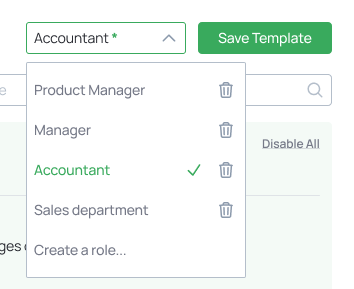
- Create a new role by choosing the corresponding variant from the dropdown list, entering its name, and pressing the Save Template button. Note that the role will be created immediately with the set of permissions that are already assigned to this admin, so you need to first assign all permissions, then create a new role.
- To assign the set of permissions from an already created role, just choose the role from the dropdown list. Note that if you haven't saved your previous set of permissions, it will be lost, and you will need to manually restore it.
- If you have assigned the set of permissions, but made some changes to the set, the admin panel will show the "*" green sign to the right of the role's name, meaning that you can press "Save" to save changes to this role.
- Roles can be deleted by pressing the "Trash can" icon in the dropdown list.
- You can just set the permissions without creating roles at all – this is an optional functionality. By default, admins do not have roles.